Follow Us:

FDA 510K

Home 510k Submission Process
Non-active device 510k process

US FDA 510k Submission Process

for Non-Active Devices

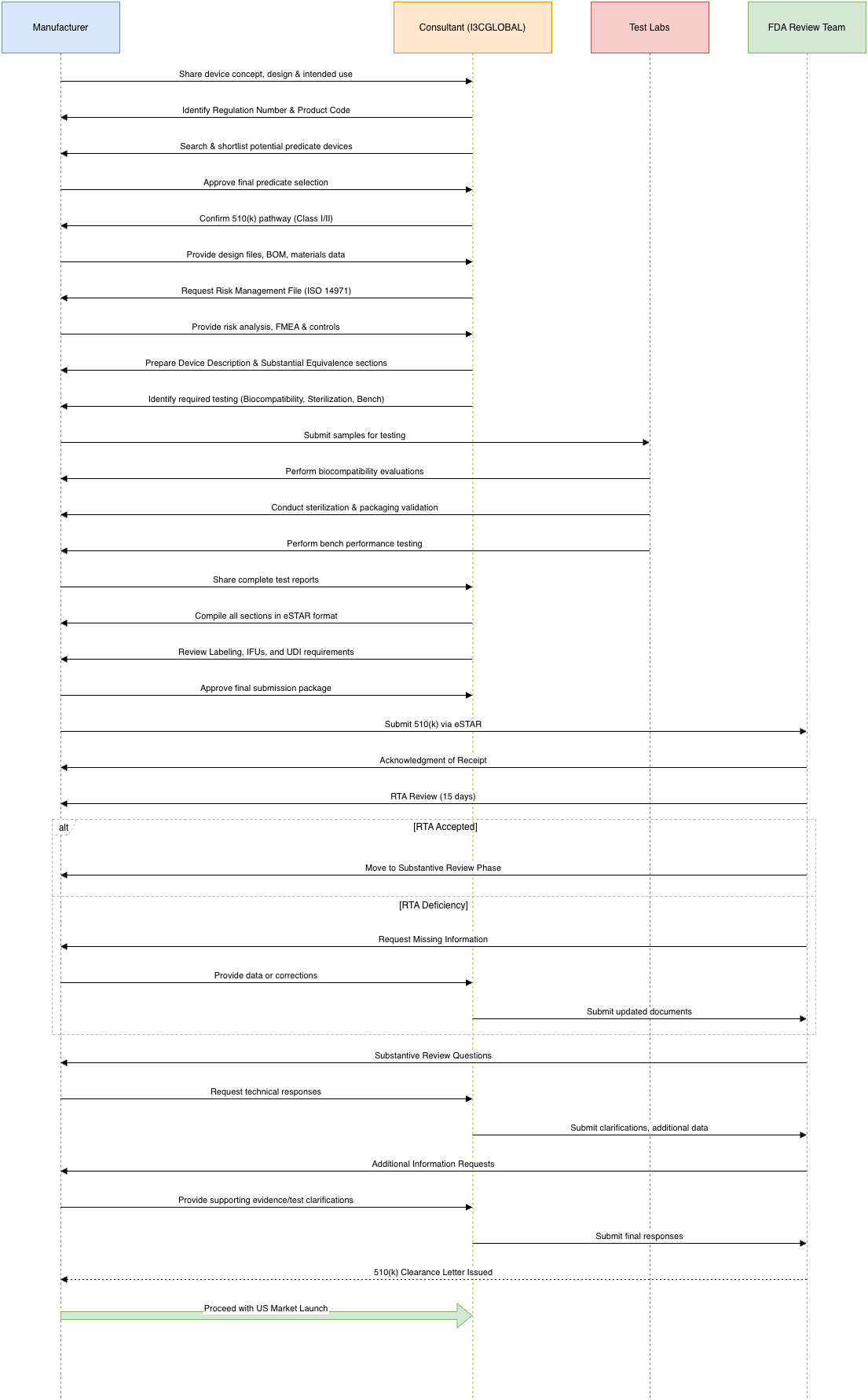
A non-active medical device is any medical device that does not rely on an energy source such as electricity, batteries, or internal power to function. These devices operate purely through manual, mechanical, or gravity based actions. They do not generate or exchange energy with the body. Non-active devices are common in medical practice and many require FDA 510(k) clearance before being marketed in the United States.

Statement of Work (SOW)

Phase 1 – Initial Details

Requirements

Scope of I3CGlobal

Scope of 510(k) Applicant

1.1 Intended use
  • Send requisition for Intended use


  • Identification of product code
  • Provide an appropriate intended use of the non-active device.


  • Confirmation of product code
1.2 Indications of Use Statement
(Form 3881)
  • Send requisition for indications for use.


  • Filling of the form based on details provided by the 510(k) applicant.


  • Assist the applicant to frame the appropriate Indications for use statement based on the intended use and product code if required.
  • Provide appropriate indications for use of the non-active device in compliance with the intended use.


  • Provide Device Name.


  • Confirm the type of Device i.e., Prescription Use or Over the Counter Use.
1.3 Device Description
  • Send requisition regarding device description to the applicant through mail communication.


  • Review of device description details shared by the applicant.
  • Preparation and documentation of Device Description template as per FDA premarket submission Guidance.
  • Provide the basic details of the non-active devices which include :
  • features of the non-active device like sizes, accessories etc.
  • Summary of the functions of the device
  •  A detailed description of the device with technology, principal, and mode of action
  • Performance testing_ Bench summary table with results for each test.
  • Formulation with CAS number, percentage ratio proportions, and supplier details
  • Material safety data sheet
  • Statement related to biocompatibility
  • diagrams or images if any
  • Manufacturing process steps involved.
1.4 Predicate Device
  • Identify and share the potential predicate device based on product code and device description.
  • Approval of a suitable predicate device.
1.5 510(K) Summary
  • Develop a template.


  • Fill in the manufacturer and device details.
  • Fills the predicate device details
  • Provide details regarding the manufacturer- name, address, contact person at the company, contact, number etc.


  • Provide details of medical device like indications of use, the material of construction, any claims etc.

Phase 2 – Non-active Device Supporting Documentation based on Intended Use & Indications for use

Document Requirements Scope of I3CGlobal Scope of 510(k) Applicant
2.1 Device Drawing
  • Send requisition for device drawing of non-active devices.


  • Review and document for 510(k) submission
  • Provide Device drawing
2.2 Material Safety Datasheet
  • Send requisition for Material safety data sheet of crucial formulation ingredients.


  • Review and document for 510(k) submission.
  • Provide Material safety data sheet of crucial formulation ingredients
2.3 Manufacturing Flow chart
  • Send requisition for Manufacturing Flow chart including all stages of the process in detail.


  • Review and document for 510(k) submission.
  • Provide the Manufacturing Flow chart
2.4 Proposed Labelling
  • Send a requisition for the Proposed Inner box label and proposed outer box label.
  • Review both the Proposed Inner box label and the proposed outer box label and provide recommendations as per FDA guidelines.
  • Provide Instructions and guidance for the User manual documentation
  • Review the User Manual and promotional material shared by the applicant and guide the recommendations as per USFDA guidelines.
  • Send a requisition for an Implant card (If an Implant device).
  • Provide guidance and instructions in Implant card documentation.

Once agreed move the labels to the submission folder 


  • Provide both the Proposed Inner box label and proposed outer box label.
  • Provide the user manual for review, following the instructions as recommended.
  • Provide the Implant card as recommended.
2.5 Sterilization
(If the device is sterile)
  • Send a requisition for the required sterilization process applicable to the device.
  • Provide instructions and guidance as per FDA guidelines.
  • Requisition for the sterilization validation and test plan and reports.
  • Review the test plan, validation, and reports.
  • Prepare sterilisation summary Report.

Once agreed move the documents to the submission folder


  • Confirm the sterilization method applicable to the device.
  • Provide the sterilization-related study plan and reports.
  • Provide approval for the final summary report.
2.6 Shelf Life
  • Requisition for shelf-life Study Plan and Reports.
  • Provide guidance on sampling for shelf life study.

Once agreed move the documents to the submission folder

  • Provide the shelf life Study Plan and Reports.


2.7 Biocompatibility
  • Send a requisition for the estimated biocompatibility endpoints of the device.
  • Provide test-specific guidance requirements as per FDA guidelines based on the contact and duration of the device.
  • Review the study plans before test performance if tests are initiated.
  • Review the study reports before conversion to the final draft.
  • Prepare a detailed summary of all tests performed.

Once reviewed and accepted move the documents to the submission folder


  • Confirm the biocompatibility estimated endpoints of the device.
  • Provide the study plans for review.
  • Provide the study report for review.
  • Provide the final copy
2.8

Performance Testing (Bench)

(Includes Transportation and Packaging Testing along with device-specific testing based on design and mode of action)

  • Send a requisition of a device-specific list of performance tests to be conducted with standards recommended by the FDA.
  • Review the test plan before testing (If testing has not been performed yet).
  • Provide the gap assessment study in case of an existing test plan and reports if applicable.
  • Prepare a detailed Performance test summary report.
  • Recommend justification for non-performed test as per FDA recommendation.
  • Prepare a detailed packaging description document.

Once reviewed and accepted move the documents to the submission folder


  • Confirm the list of performance tests recommended.
  • Share the performance study test plan and reports of all recommended tests.

Provide justification for tests not performed that are recommended by the USFDA

2.9 Risk Management File
(Recommended only based on the risk associated with the device not mandatory for every non-active device as per FDA)
  • Send a requisition for Risk Management File and Instruct to document Risk management Plan and Report identifying risk hazards, risk assessment and demonstrating that risks have been appropriately mitigated and risk management report.
  • Provide a template of Risk management plan and risk management report covering all the device-related risks on request from the applicant.
  • Review the Risk Management File data containing Plan and Report shared by the applicant and suggest the necessary corrections to document for 510(k) submission.


Once reviewed and accepted the RMF documents are moved to the submission folder

  • Provide a Risk management plan, risk assessment demonstrating that risks have been appropriately mitigated and risk management report covering all risk elements associated with device.


  • Provide the suggested corrected document.


Phase 3 – Substantial Equivalence and Executive Summary

Document Requirements

Scope of I3CGlobal

Scope of 510(k) Applicant

3.1 Executive Summary
  • Create a template and prepare the document.
  • Justify any differences between the proposed device and the predicate device.
  • Comparative study between the proposed device and the predicate device is chosen.

NIL

3.2 Substantial Equivalence Discussion
  • Create a template and prepare the document.
  • Comparative study between the proposed device and the predicate device is chosen.

NIL


Phase 4 – Administrative Documents

Document Requirements

Scope of I3CGlobal

Scope of 510(k) Applicant

4.1 510(k) Cover Letter
  • Prepare and provide a template to the applicant covering all details required for cover letter and share to the applicant instructing to use the letterhead and provide the authorized person signature.
  • The document printed on company letterhead must be signed and hard copy couriered to the US office.
  • Provide a Soft copy of signed 510(k) cover letter for 510(k)documentation.
4.2 Truthful and Accuracy Statement
  • Provide a template with the required content to be mentioned and document for submission.
  • The document signed by the contact person at the firm should be provided.
4.3 Declarations of conformity and Summary report
  • Create a template listing and prepare the document.
  • The document signed by the contact person at the firm should be provided.
4.4 MDFUSC
(FDA Form 3601)
  • Create medical device user fee cover sheet and PIN.
  • Make payment to FDA. (Before submission of 510(k) file.)


Phase 5 – Pre STAR Submission (PreSubmission/Q-Submission)

Document Requirements

Scope of I3CGlobal

Scope of 510(k) Applicant

5.1
Q-Submission (optional) Recommended prior to testing
  • Frame the questions regarding the device as per FDA guidance.
  • Arrangement of submission folder sections as per Pre-star requirement guidance.
  • Upload the documents and fill in the recommended details, ensuring the latest version template via verification.
  • Submission via CDRH Portal.

Tracking of the review process and interacting with the US FDA reviewer throughout the review process.

Confirm the Questions framed. Share the test plans and device details


Phase 6 – eSTAR Submission (Final 510(k) Submission)

Document Requirements

Scope of I3CGlobal

Scope of 510(k) Applicant


6.1


eSTAR Preparation

  • Address and Incorporate FDA Pre-Submission feedback and recommendations into the package by updating the documents.
  • Update and finalize the full technical file (510(K) file) including substantial equivalence and administrative documentations
  • Arrangement of final submission folder

Populate and validate the eSTAR’s latest version template with all required sections, attachments and rationale (if any)

  • Review and revise the technical documents addressing the FDA feedback.
  • Provide with updated inputs (test reports, labeling, risk analysis, etc.) as required.

Confirm and approve the Final Submission folder prior to eSTAR packaging.


6.2


eSTAR Submission

  • Upload the completed and validated eSTAR package to the CDRH Portal.

Verify successful submission and share FDA acknowledgment 

Provide any additional details if FDA issues RTA comments — RTA typically occurs due to user fee issues such as fee not received because of missing transaction charges or insufficient payment amount